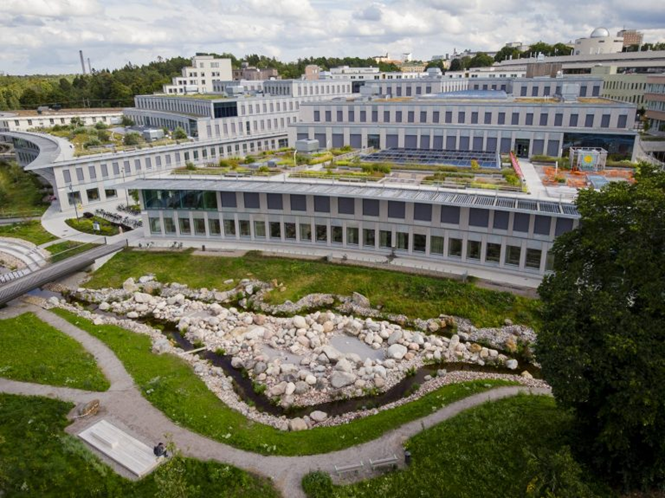
Future Island

A permanent, living artwork situated in an urban runoff stream at Campus Albano at Stockholm University that encourages public discussion on climate change.

Country

Sweden

Duration
Concept initiated in 2014 in conjunction with planning Campus Albano; artists invited in 2016; installation completed in 2023. Data transfer and public involvement started 2025. The work is designed to remain for at least 100 years.
Lead partners
Public Art Agency Sweden (Statens Konstråd), in collaboration with the Bohlin Centre for Climate Change at Stockholm University. Other partners included Akademiska Hus, Svenska Bostäder, KTH Royal Institute of Technology and Vetenskapens Hus (House of Science).
Societal areas of impact
Climate & Environmental Sustainability, Culture, Memory & Identity
Process
Joint research, Intermediation, Engagement, Dissemination

Brief Description

Future Island is a permanent, living artwork situated in an urban runoff stream at Campus Albano at Stockholm University. Created by Rotterdam-based architects/artists OOZE (Eva Pfannes and Sylvain Hartenberg) and artist/architect/researcher Marjetica Potrč, the island is divided into two climatic zones – one artificially heated to be five degrees warmer than the otherto demonstrate over time the ecological impact of global warming.

Constructed from local rock, including a 1.8-billion-year-old stone found on site, the island is both a symbolic and functional landscape. Seeds, mosses, and trees were planted in both zones to observe their contrasting development. Sensors transmit environmental data to Vetenskapens Hus (House of Science), an educational centre at KTH and Stockholm university, where school pupils and university students use it for experiments, linking artistic experience with scientific exploration.

Beyond its scientific references, the work raises questions of cultural heritage and what we leave to future generations, as it is intended to endure for a century.

Collaboration Methodology
  • Early integration of artists into the planning process before major decisions were made allowing them to explore open questions, experiment with ideas, and shape the project in dialogue with other stakeholders.
  • Workshops enabled dialogue between artists, researchers, and other stakeholders, fostering mutual understanding across disciplines.
Interview
Case study based on an interview conducted with Lotta Mossum, curator, Statens Konstråd (June 2025)
Successes
  • Involving artists from the very beginning of campus planning.
  • Genuine cross-disciplinary collaboration across art, science, and construction.
  • Strong symbolism and public accessibility of the piece.
Challenges
  • Managing cultural/professional differences across disciplines.
  • Technical challenge of creating a sustainable heating system for the island.
Needs Identified
  • Managing cultural/professional differences across disciplines.
Stakeholders & Participants

Artists

OOZE (Eva Pfannes & Sylvain Hartenberg), working at the interface of art, architecture, and urbanism (Rotterdam), and Marjetica Potrč (Berlin/Ljubljana), artist, architect, and researcher.

Researchers

From Stockholm University’s Bolin Centre for Climate Research, Stockholm Resilience Centre, and Posthumanities Hub, contributing ecological, geographical, and theoretical expertise.

Citizens

Students and pupils engaged via Vetenskapens Hus (House of Science); local community and passers-by encounter the artwork directly

Other Stakeholders

  • Curators/Facilitators: Statens Konstråd (Public Art Agency Sweden), led by curator Lotta Mossum.
  • Landscape architects & construction workers: Integrated into the project during campus construction

Knowledge Valorisation

Main Outputs

Permanent site-specific artwork (Future Island) at Campus Albano; media coverage; exhibition at the Venice Biennale Future Island in Venice – The Time of Stone

Societal Value

Encourages long-term awareness and public discussion of climate change, sustainability, and intergenerational responsibility.

Cultural Value

Embeds art as permanent infrastructure within a university landscape; positions public art as cultural heritage for future generations.

Knowledge Transfer

Provides environmental data to House of Science for use in education.

Creative Methods

Landscape-based installation art; participatory planting.

Unexpected Impact

Construction workers felt ownership of the artwork and part of the creative process, showing how art can expand ownership across diverse groups.

Partcipatory processes

Joint Research

While not scientific research per se, researchers advised on ecological aspects and planted seeds/trees to test growth in both climatic zones. Sensors provide environmental data for experiments with schools. The installation creates long-term, living evidence of climate change impacts.

Intermediation

The project brought together artists, researchers, landscape architects, and construction workers in an unusually early and integrated collaboration.

Engagement

Workshops; experiments with school classes

Dissemination

Public signs and guided visits for groups. The work itself functions as a long-term platform for awareness and dialogue on climate change.

Explore

Photo: Ricard Estay/Statens Konstråd (Public Art Agency Sweden). Artists Eva Pfannes, Sylvain Hartenberg and Marjetica Potrč.